Buying a first ping pong paddle is confusing in a very specific way: every paddle on the shelf is covered in numbers that look like specifications and are actually marketing. Speed 99. Spin 100. Control 79. None of it is standardised, none of it is comparable between brands, and none of it answers the only question a beginner has, which is what should I spend and what am I getting for it.
The short answer: spend $40 to $50, buy something with real sponge-backed rubber and an all-wood or lightly reinforced blade, and ignore everything that says "professional" on the packaging. Below is why.
The Rubber Is the Product. The Blade Is the Handle.
A ping pong paddle is two things glued together: a wooden blade, and a sheet of rubber on each face. Almost everything you feel when you hit the ball comes from the rubber. It grips the ball for a fraction of a second, and that grip is what lets you brush across the ball to make it spin instead of just knocking it forward.
This matters because it inverts the usual buying instinct. People compare blades — plies, carbon, weight — and treat the rubber as a coating. In practice a great blade with dead rubber plays like a plank, and a cheap blade with fresh grippy rubber is genuinely fun. When you pick up a paddle in a shop, press your thumb against the face and drag it. If it slides, the paddle cannot spin the ball, no matter what the box says.
It also means rubber is a consumable. Played a few hours a week, a rubber top sheet goes shiny and loses its bite in roughly six to twelve months. That is not a defect — it is the nature of the material, and it is the single biggest reason a two-year-old paddle feels worse than it did.
The Paddles Bundled With Cheap Table Sets Are Not Paddles
Nearly everyone's first experience of ping pong is with a thin plywood bat that came free with a table or a net set. These have a hard, slick rubber layer with no sponge underneath. The ball comes off them fast and flat and there is no way to make it spin, because there is nothing for the ball to grip.
Playing with one occasionally is fine. Learning on one is actively harmful, because the strokes that work with it — flat, arm-driven swats — are exactly the strokes you will have to unlearn later. A $40 paddle is a different category of object, not a slightly better version of the same one.
Ignore the Speed / Spin / Control Numbers
Every major brand prints three numbers on the packaging. They are set internally by each manufacturer, against their own range, with no external standard behind them. A STIGA rated 99 for speed and a JOOLA rated 99 for speed have no relationship to each other whatsoever.
They are not entirely useless — within one brand's line-up, a paddle rated 90 for speed really is slower than one rated 99. Across brands they are noise. Treat them the way you would treat a mattress firmness rating.
Why Beginners Should Buy a Slow Paddle
This is the recommendation people most often ignore and most often regret. A fast carbon blade is stiff: it returns energy to the ball instead of absorbing it, so the ball leaves quickly and the paddle gives you very little feedback about where on the face you hit. Every slightly late or slightly loose shot goes long.
An all-wood blade flexes. The ball stays on the face marginally longer, which does two things: it slows the shot down enough that a developing stroke can still land it, and it lets you feel the contact, which is how you correct yourself. The fast paddle is the right purchase when your good shots lack pace. It is the wrong purchase when your problem is that too many shots miss.
What About Handle Shape?
Three shapes exist and none is better than the others:
- Flared widens towards the bottom so the paddle cannot slide out of your hand. Most players and most pre-made paddles use it. If you have never held a paddle, buy this.
- Straight is a uniform cylinder, preferred by players who rotate the bat between forehand and backhand grips.
- Anatomic bulges in the middle. A minority preference; try before buying.
One rule that is not a preference: the two faces must be clearly different colours, traditionally red and black, so your opponent can see which rubber struck the ball. Any paddle with matching faces is not legal for a real match.
The Picks

Idoraz Professional Ping Pong Paddle
The right amount to risk on a sport you are still trying out. The rubber is genuinely grippy rather than the slick plastic on bundled paddles, so you can feel the ball bite when you brush it — which is the one thing that makes learning topspin possible at all. The all-wood blade is slow enough to forgive a developing stroke, and the hard case is not a token: rubber dies from dust more than from use.
Check Price on Amazon All paddle picks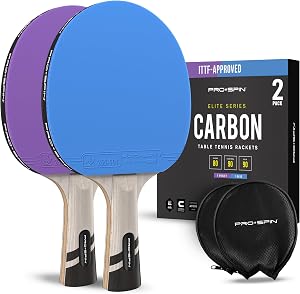
PRO-SPIN Carbon Fibre Ping Pong Paddle
A thin carbon layer inside a seven-ply blade, which is the version of carbon a beginner actually benefits from — it widens the sweet spot so off-centre hits stay on the table, without making the paddle punishingly fast. It asks for a slightly more controlled stroke than the Idoraz in exchange for more pace when you want it. If you already know you are going to keep playing, start here instead of buying twice.
Check Price on Amazon
JOOLA Match Pro
A five-ply all-wood allround blade, which is the classic coaching recommendation for a reason. The wood flexes and tells you where on the face you hit the ball, and that feedback is what turns practice into improvement. There is no carbon and no cleverness here, and that is the point — it rewards technique rather than covering for its absence. The paddle to buy if you intend to actually get good.
Check Price on AmazonWhat Not to Buy Yet
Two things, both tempting.
The first is a $110 carbon paddle. It is a better object and it will make you worse for the first few months, because it converts small technical errors into balls off the end of the table. Buy it when consistency is no longer your limiting factor.
The second is a custom setup — a blade and two rubbers bought separately and glued yourself. That is genuinely the better long-term route and it is covered in our guide to blades and rubbers versus pre-made paddles, but it only pays off once you know what you want the equipment to do. Before then you are guessing with more steps.
Buy the Idoraz if you are still finding out whether you like ping pong. Buy the PRO-SPIN if you already know you will keep playing and want one paddle that lasts. Buy the JOOLA Match Pro if you want to learn correct strokes and are willing to be patient with a slower blade. Do not buy a carbon paddle as your first paddle, and do not buy anything that came free with a table.
Frequently Asked Questions
How much should a beginner spend on a ping pong paddle?
Between $40 and $50. Below about $30 you are usually buying slick rubber that cannot grip the ball, which makes learning spin impossible. Above about $70 you are paying for speed that a developing stroke cannot control yet. The $40 to $50 band buys real sponge-backed rubber on a forgiving blade, which is everything a beginner needs.
Is a more expensive ping pong paddle actually better?
It is a better piece of equipment and often a worse purchase. Expensive paddles are faster and stiffer, which rewards a technically sound stroke and punishes a loose one. If your rallies end because shots go long, a faster paddle makes that worse. Upgrade when your good shots feel underpowered, not when your shots are inconsistent.
What does ITTF approved mean?
The International Table Tennis Federation publishes a list of rubbers legal for sanctioned competition. It is a legality check rather than a quality score. Plenty of excellent recreational rubber is not on the list, and inclusion does not make a paddle good. It only matters if you plan to enter tournaments.
How long does a ping pong paddle last?
The blade lasts years. The rubber does not. With a few hours of play a week, expect the top sheet to lose its grip in roughly six to twelve months, and you will notice it as serves that stop kicking. On a pre-made paddle, replacing the rubber costs about what the paddle did, which is why committed players eventually move to a separate blade and rubbers.
Do I need red and black sides?
For casual play, no. For any match played under the rules, yes. The two faces must be clearly different colours so your opponent can tell which rubber you used, since different rubbers produce different spin. Red and black is the traditional pairing, though other contrasting colours are now permitted.