A ping pong paddle — a table tennis racket, if you want the official term — is a blade with a sheet of rubber glued to each side. That is the whole product. The blade sets the speed and the feel; the rubber does almost all of the work of gripping the ball and creating spin. Almost everyone buying their first paddle overspends on the blade and ignores the rubber, which is backwards: a worn rubber on a great blade plays worse than fresh rubber on a cheap one. Below are six pre-assembled paddles that make sense at their price, plus an honest note on when a pre-made paddle stops being enough.
Last updated: September 2026
| Paddle | Tier | Blade | Level | Score |
|---|---|---|---|---|
| Idoraz Professional | Budget | 7-ply wood | Beginner | 8.3 |
| PRO-SPIN Carbon Fibre | Budget | 7-ply + carbon | Beginner+ | 8.4 |
| JOOLA Match Pro | Best Value | 5-ply wood | Intermediate | 8.5 |
| Killerspin Jet 600 Spin N2 | Best Value | 5-ply wood | Intermediate | 8.6 |
| STIGA Pro Carbon Blast | Premium | 7-ply + carbon | Advanced | 8.9 |
| JOOLA Infinity Overdrive | Premium | Carbon composite | Advanced | 9.0 |
First Real Paddles
A genuine step up from whatever came with the table
A well-judged first paddle. The rubber is genuinely grippy rather than the slick plastic found on bundled paddles, so you can actually feel the ball bite when you brush it — which is the single thing a beginner needs in order to learn topspin at all. The all-wood blade is slow enough to be forgiving, and the included hard case is not a token gesture; it stops the rubber picking up dust, which is what kills grip fastest.
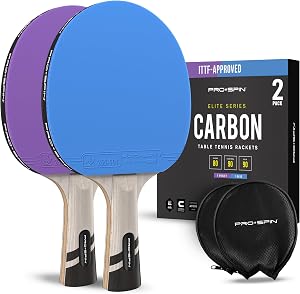
The carbon layer widens the sweet spot, which is the part of a carbon blade a beginner actually benefits from — off-centre hits stay on the table instead of dying. It is quicker than the Idoraz and asks for a slightly shorter, more controlled stroke in return. If you have played casually for a while and want one paddle that will still make sense in a year, this is the sensible end of the budget tier.
The Step-Up
Where a player who has learned to loop should land
An all-wood allround blade, which is the classic recommendation for a player learning proper strokes, and JOOLA build it well. The five plies give a soft, readable feel — you can sense where on the blade you hit the ball, which is how you correct yourself. There is nothing exotic here and that is the point: it rewards technique rather than covering for the lack of it.

Killerspin build this around the rubber rather than the blade, and it shows: the Nitrx sheet grips hard and generates noticeably more spin than anything in the budget tier. That makes it a good match for someone whose game is starting to revolve around looping and serving with sidespin. The trade is that the extra grip makes returns of heavy spin harder to control until you learn to angle the bat.
Performance Grade
Carbon blades and tournament rubbers, ready to play
Fast, stiff and unapologetically offensive. The carbon layers make the blade rigid, so energy goes back into the ball rather than into flex, and the sweet spot is large for a blade this quick. It suits a player who attacks third ball and finds slower paddles blunting their put-aways. It is not a forgiving paddle — loose blocks will fly long — but that is the deal you are making.

The most complete pre-assembled paddle here, and the closest a ready-made bat gets to a custom setup. The carbon blade is fast without being harsh, and the rubber is approved for sanctioned play, so you can take it to a tournament without swapping anything. Buy it if you want performance now and have no interest in gluing rubber yourself — otherwise, at this price, a separate blade and two rubbers gives you more.
How to Choose a Ping Pong Paddle
The Rubber Matters More Than the Blade
Spin comes from the rubber gripping the ball for a fraction of a second. A fresh, grippy sheet will out-spin an old one on the same blade, and rubber wears out — with a few hours of play a week, the top sheet goes shiny and loses bite in roughly six to twelve months. If your shots have stopped biting, replace the rubber before you replace the paddle.
Ignore the Speed / Spin / Control Numbers
Nearly every paddle is sold with three numbers, usually something like Speed 99, Spin 100, Control 79. There is no standard behind them. They are set by each manufacturer for their own range and cannot be compared between brands — a STIGA 99 and a JOOLA 99 mean nothing to each other. Use them to compare two paddles within one brand's line-up, and nowhere else.
Control Beats Speed Until Your Technique Catches Up
A fast carbon blade punishes a late or loose stroke by sending the ball long. Beginners nearly always play better with an all-wood or lightly reinforced blade, because the extra dwell time gives them a chance to keep the ball on the table. Buy the fast paddle when your problem is that your good shots lack pace, not when your problem is consistency.
Handle Shape Is Personal, Not Better or Worse
Flared handles widen towards the bottom and stop the paddle sliding out of your hand — most players use them and most pre-made paddles ship with one. Straight handles suit players who rotate the bat between forehand and backhand grips. Anatomic sits between the two. None is objectively better; if you have never held one, buy flared.
When to Stop Buying Pre-Made Paddles
A pre-assembled paddle is the right buy until you can consistently loop against backspin and you know which rubber characteristics you want. At that point you are better off buying a blade and two rubbers separately — you can then replace a worn rubber for a fraction of the cost of a new paddle, and tune each side independently. Our blades and rubbers page covers that step.
Frequently Asked Questions
What ping pong paddle should a complete beginner buy?
An all-wood or lightly reinforced blade with inverted (smooth) rubber, in the $30 to $50 range. That is enough paddle to learn every stroke properly, and cheap enough that you have not wasted much when you discover which style of play you prefer. Avoid the thin plywood paddles bundled with cheap table sets — the rubber on them has almost no grip, so you physically cannot learn to spin the ball with one.
Is an expensive paddle actually worth it?
Only once your technique can use it. A $110 carbon paddle gives you more speed and a bigger sweet spot, but it also sends loose shots off the end of the table. If you are still learning to keep rallies going, that money is better spent on a decent $40 paddle, a box of 3-star balls and a net. If you are already looping consistently and your shots feel underpowered, the upgrade is real.
What does ITTF approved mean on a paddle?
The International Table Tennis Federation maintains a list of approved rubbers, and only rubbers from that list may be used in sanctioned competition. It is a legality check, not a quality rating — plenty of excellent recreational rubber is not on the list, and being on it does not make a paddle good. It only matters if you intend to enter tournaments.
How often should I replace my paddle?
Replace the rubber, not the paddle. A blade lasts years — decades, if you do not chip it. Rubber that is played a few hours a week loses its grip in about six to twelve months, and you will feel it as spin that no longer bites. On a pre-made paddle, gluing on new rubber costs about as much as the paddle did, which is exactly why serious players move to a separate blade and rubbers.
Should the paddle have red on one side and black on the other?
Yes, if you ever want to play a match under the rules. The two sides must be clearly different colours — traditionally red and black, though other contrasting colours are now allowed — so your opponent can see which rubber you struck the ball with. Every paddle on this page follows that rule.