Table tennis is unusually hard to practise alone. You cannot serve to yourself, you cannot rally against a wall in any way that resembles the real thing, and the sport's core skill — reading spin and responding in under half a second — needs a ball coming at you.
That is why robots exist, and why they are worth more in this sport than a ball machine is in most others. But the honest answer to whether one is worth it has a condition attached, and a cheaper thing you should buy first.
Buy the Catch Net First. Genuinely.
A robot with a hundred-ball hopper empties in around three minutes. Without a recycling net, you then spend five minutes collecting balls off the floor. Two thirds of your session is crawling around under a table.
A catch net attaches across the far half of the table and funnels every ball you hit into one collection point, so the robot feeds continuously and you hit continuously. It costs a fraction of a robot and it is what makes a robot usable rather than infuriating.
There is a stronger version of this argument. A catch net also transforms multiball practice with a human partner — one person feeds, the other hits, and nobody stops. Plenty of people who thought they wanted a robot actually wanted a catch net and a training partner.
What a Robot Genuinely Improves
Stroke mechanics, above everything else.
Because every ball arrives in the same place with the same spin at the same speed, you can hit two hundred forehand loops and feel the difference between the ones that worked and the ones that did not. In a rally that is impossible — every ball is different, so you never repeat anything precisely enough to isolate what you changed.
It is also the only realistic way to drill against heavy backspin over and over. Finding a partner willing to chop two hundred balls at you is hard. A robot does not get bored.
Footwork drills are the third real use, provided the robot oscillates — moving the landing point side to side forces you to actually move rather than reach.
What a Robot Cannot Teach You
This is the part robot listings do not mention, and it is a large part of the sport.
- Serving. A robot never receives, so your serve gets no practice and no feedback at all.
- Reading spin. A robot's ball has no disguise. You know what is coming because you programmed it. Reading an opponent's bat angle and contact is a separate skill that a robot actively cannot develop.
- Tactics and pressure. Point construction, choosing when to attack, and playing a decisive point are all absent.
- Correcting faults. A robot repeats. If your forehand has a technical flaw, a robot lets you practise that flaw two hundred times an hour with great consistency.
That last point is the important one. The productive combination is a coach or a strong club player telling you what to change, and a robot letting you drill the change until it is automatic. A robot alone tends to produce players with attractive strokes who lose to people who read spin better.
The Honest Test
Ask yourself whether you currently practise or whether you play.
If you already do drills — deliberately repeating a shot with the intention of improving it — a robot is the highest-value purchase available to you and it will pay off within weeks. If you turn up, play games, and go home, a robot will be used twice and then live under the table. That is not a character flaw; it is just a different relationship with the sport, and $300 is a lot to spend discovering it.
What to Pay For, In Order
- Oscillation — side-to-side placement. This is what turns a stroke drill into a real one by making you move your feet.
- Adjustable spin — so you can drill against topspin and backspin separately rather than one fixed feed.
- Programmable sequences — chaining different shots into a realistic pattern. This is the main thing separating a premium robot from a basic one.
- Ball capacity and recycling — how long you can go before stopping.
One practical note: feed it cheap balls. A robot chews through them, jams occasionally, and fires a few over the barrier. Use bulk 3-star or even 1-star balls — see our guide to ping pong ball star ratings — and keep good balls for games. Mixing brands in one hopper is a common cause of jams.
The Picks

JOOLA iPong Carbon Fibre Ball Catch Net
The single most useful accessory in solo table tennis, and the thing to own before any robot. It attaches across the far half of the table and funnels every ball you hit into one collection point, turning a robot session into continuous hitting rather than hit-then-crawl. Works with any robot and with a partner feeding multiball. If you own a robot and not one of these, you are wasting most of your practice time.
Check Price on Amazon All training aid picks
iPong Original Table Tennis Trainer Robot
The robot that made solo practice affordable and still a reasonable place to start. It sits on the far end of the table, feeds topspin or backspin at an adjustable rate, and does not oscillate — so you drill one stroke from one position at a time. Simple to the point of crude, which is exactly why it keeps working. A genuine training tool rather than a gadget.
Check Price on Amazon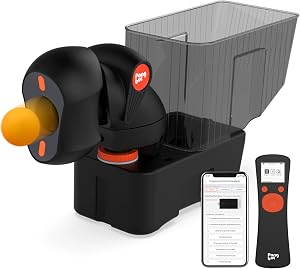
PONGBOT App-Control Table Tennis Robot
App control matters because of drill sequences: instead of two hundred identical forehands, you chain a backspin push, a topspin loop and a block into a pattern that resembles an actual point. The pre-saved library is a genuinely good starting point and spin and speed are customisable per shot. This is where a robot stops drilling strokes and starts drilling table tennis.
Check Price on AmazonA robot is worth it if you already practise deliberately and cannot always find a partner — it fixes stroke consistency faster than anything else available. It is not worth it if you mainly play social games, because it will be used twice. Either way, buy the catch net first: it costs a fraction as much, it makes a robot usable, and it might turn out to be the only thing you actually needed.
Frequently Asked Questions
Is a table tennis robot worth the money?
If you play regularly and practise deliberately, yes — it is the most effective solo training available and it improves stroke consistency faster than anything else. If you mainly turn up and play social games, no: it will be used a couple of times and then stored. The honest test is whether you already do drills, or whether you only play matches.
What should I buy first, a robot or a catch net?
The catch net, without hesitation. It costs a fraction as much and multiplies the value of everything else, because it returns balls to one point instead of scattering them across the floor. It also makes multiball practice with a human partner work properly. Many people find that a catch net plus a training partner covers everything they wanted a robot for.
Can a table tennis robot replace a coach?
No. A robot repeats; a coach corrects. If your stroke has a technical fault, a robot will happily help you practise that fault two hundred times an hour. The productive setup is a coach or strong club player identifying what to change, and a robot letting you drill the change until it becomes automatic.
How many balls do I need for a ping pong robot?
At least 100, ideally 200. A hopper empties in a few minutes and the point of a recycling setup is not stopping. Use cheap bulk balls rather than match balls, and use all the same type — mixing brands and grades in one hopper is one of the most common causes of jamming.
Do cheap table tennis robots actually work?
The entry-level ones feed a consistent ball with basic topspin or backspin and no side-to-side movement, which is genuinely enough to groove a single stroke. What you give up is oscillation, fine spin control and programmable sequences. If you know you will use it, the mid-range models are where the value sits; the cheapest ones are fine for one-shot repetition and not much more.