Table tennis is unusually hard to practise alone, which is why robots exist and why they are worth more here than in most sports. A robot fires a ball to the same place, with the same spin, as many times as you want — and repetition against a consistent ball is precisely how a stroke gets grooved. What a robot cannot do is read you, vary spin unpredictably or teach you to serve. Buy one to drill technique, not to replace a partner. And buy the catch net first: without one you will spend more of the session picking up balls than hitting them.
Last updated: September 2026
| Trainer | Tier | Type | Control | Score |
|---|---|---|---|---|
| Retractable Ball Collector | Budget | Collector | Manual | 7.8 |
| JOOLA iPong Catch Net | Budget | Catch net | Passive | 8.4 |
| iPong Original Trainer | Best Value | Robot | Dial | 8.0 |
| Suz S102 Remote Trainer | Best Value | Robot | Remote | 8.1 |
| Suz S201 with Recycling Net | Premium | Robot | Remote | 8.6 |
| PONGBOT App-Control Robot | Premium | Robot | App | 8.7 |
Stop Chasing Balls
The cheap kit that makes solo practice actually work
A tube that picks balls off the floor by being pressed onto them, holding well over a hundred before it needs emptying. Deeply unglamorous and the best twenty pounds in solo training: it turns the five-minute collection break between robot hoppers into about forty seconds. If you do any multiball work at all, buy one before you buy anything else here.

The single most useful accessory in solo table tennis. It attaches across the far half of the table and funnels every ball you hit into one collection point, so a robot session becomes continuous hitting instead of hit-then-crawl. Works with any robot and with a partner feeding multiball. If you own a robot and not one of these, you are wasting most of your practice time.
First Robots
Consistent feeding without a four-figure price
The robot that made solo practice affordable, and still a reasonable first one. It sits on the far end of the table, feeds topspin or backspin at an adjustable rate, and does not oscillate — so you drill one stroke at a time from one position. Simple to the point of crude, and that simplicity is why it keeps working. A genuine training tool, not a toy.

A step up from the dial-only robots mainly because of the remote: you can change speed and spin without walking to the far end of the table, which sounds trivial and completely changes how much you actually vary your drills. Setup is quick and it packs down small. A sensible middle option if a programmable robot is more than you need.
Programmable Robots
Drill sequences, spin control and continuous recycling
The complete package: robot, recycling net and two hundred balls in one purchase, which is the combination that actually delivers an hour of unbroken practice. Buying the three separately costs about the same, so the value is in not having to work out whether the net fits the robot. Best pick if you are starting from nothing and intend to train seriously.
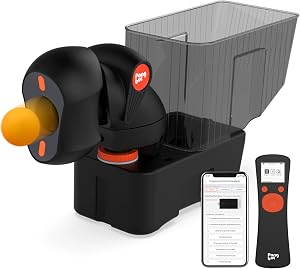
The point of app control is drill sequences: instead of two hundred identical forehands, you chain backspin push, topspin loop and block into a pattern that resembles an actual point. The pre-saved drills are a genuinely good starting library and you can customise spin and speed per shot. This is where a robot stops drilling strokes and starts drilling table tennis.
How to Choose a Table Tennis Robot
Buy the Catch Net Before the Robot
A robot with a 100-ball hopper empties in about three minutes. Without a recycling net, you then spend five minutes collecting balls off the floor — so two thirds of your session is crawling around. A catch net returns balls to the robot automatically and turns the same hour into continuous hitting. If your budget only covers one item, a catch net plus a friend beats a robot alone.
What a Robot Genuinely Improves
Stroke mechanics and footwork patterns. Because every ball arrives identically, you can hit two hundred forehand loops and feel the difference between the good ones and the bad ones, which is impossible in a rally where every ball is different. It is also the only realistic way to drill against heavy backspin repeatedly. Expect real improvement in consistency within a few weeks of regular use.
What a Robot Cannot Teach You
Serving, receiving, reading an opponent's body, and match tactics — all of which are large parts of the game. A robot ball has no disguise: you know what is coming and when. Players who train exclusively on a robot tend to have beautiful strokes and get beaten by people who read spin better. Use it as one part of practice, not all of it.
Oscillation, Spin and Programmability
The three features worth paying for, in that order. Oscillation moves the landing point side to side so you have to move your feet, which is what turns a stroke drill into a real one. Adjustable spin lets you drill against backspin and topspin separately. Programmable drill sequences — usually via an app — let you chain shots into realistic patterns, and are the main thing separating a premium robot from a basic one.
Feed It Cheap Balls
A robot will chew through balls, jam occasionally and send a few over the barrier into whatever is behind the table. Do not feed it match balls. Buy the cheapest 3-star or even 1-star balls in bulk — see our ping pong balls page — and keep your good balls for games. Mixing ball types in a hopper also causes jams, so pick one and stick to it.
Frequently Asked Questions
Is a table tennis robot worth it?
If you play regularly and cannot always find a partner, yes — it is the most effective solo practice available and it fixes stroke consistency faster than anything else. If you play a few casual games a month, it is not: you will use it twice and then it will live under the table. The honest test is whether you already practise deliberately, or just play.
What should I buy first, a robot or a catch net?
The catch net, without hesitation. It costs a fraction as much and it multiplies the value of everything else — it makes multiball practice with a partner work, and it is what makes a robot usable rather than infuriating. Many people find that a catch net plus a training partner covers everything they needed a robot for.
How many balls do I need for a ping pong robot?
At least 100, ideally 200. A hopper empties in a few minutes and the whole point of a recycling setup is not stopping. Use cheap bulk balls rather than match balls, and use all the same type — mixing brands and grades in one hopper is a common cause of jamming.
Can a robot replace a coach?
No. A robot repeats; a coach corrects. If your forehand has a technical fault, a robot will help you practise that fault two hundred times an hour. The productive combination is a coach or a good club player telling you what to change, and a robot letting you drill the change until it is automatic.
Do cheap ping pong robots actually work?
The entry-level ones feed a consistent ball with basic topspin or backspin and no oscillation, which is genuinely enough to drill a stroke. What you give up is side-to-side movement, fine spin control and programmable sequences. If you know you will use it, the mid-range models are where the value sits; the cheapest ones are fine for one-shot repetition and little else.