Ping pong balls are the cheapest thing in the sport and the easiest to get wrong. Since 2014 the standard has been a 40+ millimetre plastic ball, which replaced the old celluloid one — if a listing still says celluloid, it is old stock. The number of stars is the thing to understand: it is a consistency grade, not a durability rating. A 3-star ball is round, evenly weighted and bounces the same every time; a 1-star ball is none of those things, which is fine for feeding a robot and useless for a match.
Last updated: September 2026
| Ball | Tier | Grade | Best Use | Score |
|---|---|---|---|---|
| MAPOL 100-Count Orange | Budget | 3-star | Practice | 8.1 |
| KEVENZ 3-Star 40+ | Budget | 3-star | Practice | 8.2 |
| STIGA 3-Star | Best Value | 3-star | Games | 8.3 |
| PRO-SPIN High-Performance | Best Value | 3-star | Practice / games | 8.4 |
| DHS D40+ 3-Star | Premium | 3-star ITTF | Match | 8.8 |
| Nittaku 3-Star Premium | Premium | 3-star premium | Match | 9.1 |
Bulk Practice Balls
Buy these by the hundred and stop worrying about losing them
A hundred orange balls for the price of a takeaway. Orange is the right call for a garage or basement where a white ball vanishes against a pale floor, and at this quantity you can genuinely run a full multiball session without collecting. Individual balls vary a little more than a premium 3-star ball, which you will never notice while a robot is firing them at you.

The default answer to "I need a lot of balls and I do not want to think about it". Consistency is good enough that they do not feel obviously worse than a match ball in a rally, and they are cheap enough per ball that losing one under the sofa costs nothing. They are the balls to buy for a robot hopper, for multiball feeding, and for a household where balls disappear.
Everyday 3-Star
Consistent enough for real games without match-ball pricing
STIGA have been making table tennis equipment since 1944 and their quality control shows in how little variation there is between balls in a box. These are for the table you actually play games on: they bounce true, they hold up to normal hitting, and they cost meaningfully less than the Japanese match balls. A sensible default for a home table.
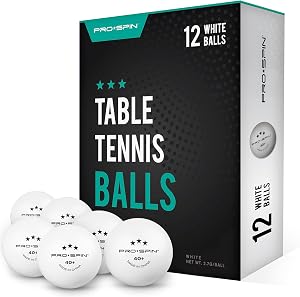
A step up in batch consistency from the bulk options without a real step up in price, and sold in small or large packs so you can buy a dozen for the table drawer or sixty for training. The bounce is even enough for club-level games. If you want one ball that covers both practice and casual matches without keeping two boxes, this is the pick.
Match Grade
ITTF-approved balls for tournaments and serious training
DHS is the Chinese national team's supplier and the D40+ is a genuine match ball at a price that does not sting. ITTF approval means it is legal for sanctioned competition and, more usefully for most people, that the tolerances are tight — the ball you serve with in practice behaves exactly like the one you will serve with in a match. The best value in the premium tier.

Nittaku's premium ball is the one many serious players quietly consider the benchmark, and it is priced accordingly — you are buying a handful of balls for what a hundred practice balls cost. What you get is exceptional roundness and a bounce that does not drift across a box. Worth it if you train seriously and want your practice ball to be indistinguishable from a tournament ball; overkill for anything else.
How to Choose Ping Pong Balls
What the Stars Actually Mean
The star rating grades consistency: roundness, weight distribution and bounce height, measured across a batch. Three stars is the top grade and the only one used in serious competition. One and two star balls come off the same production lines but fail the tolerances, so they wobble slightly and bounce a little differently from one another. That is irrelevant when a robot is feeding you 200 balls and very relevant when you are trying to read spin.
40+ Plastic, Not Celluloid
The sport moved from 40mm celluloid to 40+ plastic balls in 2014. Plastic balls are slightly larger, marginally slower, take less spin and are noticeably louder. Every ball on this page is 40+ plastic. The practical reason it matters: if you learned on celluloid and your old stock finally ran out, your serves will bite less with plastic and that is the ball, not you.
Buy Practice Balls by the Hundred
The correct number of balls to own is more than you think. Multiball drills, robot work and simply not interrupting a session to crawl under the table all argue for buying a hundred at a time. Orange and white play identically — orange is easier to spot against a light floor or a pale wall, which is the only reason to prefer it.
ITTF Approved Is a Competition Rule
An ITTF-approved ball has passed the federation's testing and may be used in sanctioned events. For a home game it buys you nothing except very tight consistency. It is worth paying for if you are training seriously and want your practice ball to behave exactly like your match ball, and it is a waste of money if the balls are going to spend their lives being trodden on.
Seams, Seamless and Durability
Most balls are moulded in two halves and joined, leaving a seam; some premium balls are seamless. In practice a well-made seamed ball plays fine and seams are not the reason balls crack. Balls crack from being stepped on and from hard smashes into the table edge. Expect to lose a few from any batch — that is normal, and another argument for buying in bulk.
Frequently Asked Questions
Are 3-star ping pong balls worth the extra money?
For matches, yes. A 3-star ball bounces identically every time, which means when the ball does something odd you know it was the spin and not the ball. For robot feeding, warm-ups and multiball drills, cheaper balls are genuinely fine and you will get through far more of them. Most players who train seriously keep both: a bulk bag for drills and a small box of match balls.
What is the difference between orange and white ping pong balls?
Nothing but visibility. They are made to the same specification and play identically. Choose whichever contrasts better with your floor, walls and the shirts people play in — orange usually wins in a garage or basement, white in a hall with dark surroundings. Official matches use whichever colour the venue specifies.
What size is a regulation ping pong ball?
40+ millimetres in diameter and 2.7 grams, made of plastic. The plus sign is not decoration — it reflects the fact that the plastic balls introduced in 2014 run slightly over 40mm, where the old celluloid ones were exactly 40mm. Anything sold as 38mm is pre-2000 stock and no longer legal for play.
How many ping pong balls should I buy?
If you only play casual games, a box of six 3-star balls will last a long time. If you own a robot or do any multiball training, buy a hundred at a time — a robot empties a fifty-ball hopper in a couple of minutes, and stopping to collect balls every two minutes ruins the point of the drill. A ball collector or catch net pays for itself quickly at that volume.
Why do my ping pong balls crack so quickly?
Almost always because they are being stood on. Plastic 40+ balls are tough against normal hitting but split when compressed, so the killer is a foot rather than a smash. Collect balls off the floor before you move around the table, and keep them out of direct sun and hot cars, which makes the plastic brittle.