A regulation pickleball net is 22 feet wide, 36 inches high at the posts and 34 inches at the centre. Every net here meets that. What separates them is not dimensions but three practical things: how long setup takes (a good system is four to seven minutes for one person), whether the centre sags after twenty minutes of play, and how it behaves in wind. Heavier bases are steadier but nobody wants to carry them far — that trade is the whole decision.
Last updated: September 2026
| Net | Tier | Setup | Frame | Score |
|---|---|---|---|---|
| A11N Portable | Budget | ~7 min | Steel | 7.8 |
| Boulder Portable | Budget | ~6 min | Steel | 7.9 |
| Rally Portable | Best Value | ~5 min | Steel | 8.4 |
| Franklin Portable | Best Value | ~5 min | Steel | 8.6 |
| Pro Hand-Winch Net | Premium | ~7 min | Heavy steel | 9.0 |
| ONIX Portable | Premium | ~4 min | Steel | 9.1 |
Occasional Use
Fine for the driveway a few times a month
The cheapest net here that is still regulation width and does not fall over. Setup is slower than the better systems because the poles are not captive, and the centre will sag over a long session without re-tensioning. For a few games a month on a driveway that is perfectly acceptable, and it packs down smaller than most.
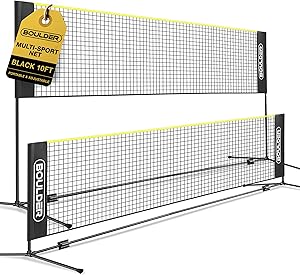
A step up from the A11N mainly in the parts that usually fail first: the frame is powder-coated so it survives being left damp, and the carry bag has a reinforced base rather than a thin drawstring sack. Play-wise it is very similar — expect some centre sag — but it will still be usable in two years, which is not guaranteed at this end of the market.
The Home Default
What most people should buy for regular play
Very close to the Franklin, with a slightly more substantial centre stabiliser bar that holds tension noticeably better over a long session. Worth choosing over the Franklin if your group plays for hours rather than a quick game, or if you have been annoyed by sag on a previous net. Marginally heavier to carry as a result.

The default answer when someone asks which net to buy, and deservedly so. The snap-together frame goes up in about five minutes without tools, and the centre stabiliser keeps the height honest through a full session. It is not the sturdiest option in wind, but for driveway and park play it does everything most people need and has a reputation for surviving years outdoors.
Club Grade
Stable in wind and built for daily setup
The closest thing here to a club net. A hand winch tensions the net properly rather than relying on a strap, which is what finally kills centre sag over a long session, and the heavy frame stays planted in conditions that shift a standard portable. Locking wheels mean you roll it into position rather than carry it — which is the trade: this lives at a court, it does not go to the park.

The best balance of setup speed and stability here. The tension system keeps the net taut at the correct height without re-adjusting mid-session, and the reinforced frame stays planted in a way the cheaper nets do not. It also ships with a 10-foot practice net for solo drilling, which is genuinely useful and something no other option here includes.
Choosing a Portable Pickleball Net
Centre Sag Is the Real Test
Almost every portable net looks fine when you first put it up. The difference shows after twenty minutes: cheaper systems sag in the middle, so the net height drops below regulation and balls that should clip the tape sail over. A centre stabiliser bar or a proper tensioning system is the feature worth paying for, and it is what separates the value tier from the budget tier here.
Weight Is a Genuine Trade-Off
Heavier bases resist wind and stay put during play, but you have to carry the thing from the car. If your net lives in the garage and comes out onto the driveway, weight barely matters. If you carry it to a park, every pound counts. Be honest about which of those you actually are before buying the heaviest option.
Setup Time Compounds
A net that takes twelve minutes to assemble gets used less than one that takes four. If you are setting up and packing down every session, that difference is the reason a net either gets played on or lives in the garage. Snap-together frames with colour-coded or captive poles are meaningfully quicker than systems with loose bolts.
Check the Bag Before You Buy
The carry bag is the first thing to fail on cheap systems, and a net you cannot transport is a net you stop using. Look for a bag with a reinforced base and a real shoulder strap rather than a thin drawstring sack. It sounds trivial until the seam splits in a car park.
Frequently Asked Questions
What size is a regulation pickleball net?
22 feet wide, 36 inches high at the sideline posts and 34 inches high at the centre. The court itself is 20 feet by 44 feet, so the net is slightly wider than the court. Every net on this page meets regulation dimensions — the differences are in stability and setup, not size.
How long does a portable pickleball net take to set up?
Four to seven minutes for one person with a good system, once you have done it a couple of times. Cheaper nets with loose bolts and uncoded poles can take twice that. If you set up and pack down every session, that difference matters more than almost any other feature.
Can I use a portable net in wind?
Up to a point. Standard portable nets get pushed around in anything above a light breeze because the bases are designed to be carryable. If wind is a regular problem where you play, look for a heavier-based system — the weight is the whole point, and it is why the premium options here cost more and carry worse.
Will a portable net work on grass?
It will stand up, but it will not play well. Grass is uneven so the net height varies across the width, and the bases sink slightly, which makes the centre sag worse. Pickleball genuinely needs a hard, flat surface — a driveway, a tennis court or a sports hall.
Do I need a net or can I just use a tennis net?
A tennis net is too high — 42 inches at the posts against pickleball's 36 — and too wide for the court. Some tennis facilities have adjustable systems that can be lowered. If you are playing on a tennis court regularly, a portable pickleball net set up inside the tennis court is the normal solution.