The training aids worth owning do one of two jobs: they give you repetitions you cannot get without a partner (tethered rebounders return the ball after every serve or swing), or they block one specific fault (a passing trainer that stops you bending your arms, a net extender that punishes a low contact point). Everything on this page is from Tandem Sport, which has made these tools since 1989 and is what most US club programmes actually own. Buy for a named problem — an aid you bought "to get better" ends up in the garage.
Last updated: September 2026
| Training Aid | Tier | Trains | Best For | Score |
|---|---|---|---|---|
| Tandem Volleyball Pal | Budget | Serving | Solo practice anywhere | 8.4 |
| Tandem Pass Rite | Budget | Passing form | Beginners bending arms | 8.0 |
| Tandem Spike Pal | Best Value | Arm swing | Solo hitting reps | 8.5 |
| Tandem Net Extender | Best Value | Contact height | Team drills | 8.3 |
| Tandem Spike Trainer | Premium | Hitting technique | Coaches & clinics | 9.0 |
| Tandem Collapsible Spike Trainer | Premium | Hitting technique | Travelling coaches | 9.2 |
Under $35
Single-skill tools a player can use alone in a garden or driveway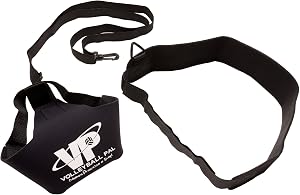
The best value in volleyball training, and the reason is simple arithmetic: a waist strap, an elastic cord and a neoprene ball pouch mean the ball comes back after every serve, so a player gets four or five times the repetitions per hour of practising alone. Parents buy this one and report their kid actually uses it, which is more than can be said for most training gear. The common complaint is that the cord is short for tall players — check the length before you buy for an adult.

A resistance sleeve that sits across the upper arms and physically prevents the elbows bending during a forearm pass — the single most common fault in new players and the hardest to fix by being told about it. Ten minutes wearing this teaches the platform better than a season of "straighten your arms". It is a coaching aid rather than a fitness product, so it comes off once the habit sticks; borrow-and-share among a team is entirely reasonable.
$35 – $60
Tools that upgrade a whole practice, not just one player
The Volleyball Pal's hitting sibling: an elastic cord with a carabiner clips to a basketball hoop, a pole or any solid overhead point, and the ball returns after every swing. The cord length adjusts for player height, so it works for a 12-year-old and an adult from the same hook. It teaches contact point and a full arm swing rather than power, and because it removes ball-chasing entirely, it is the aid that most reliably turns 20 minutes into real volume.

A simple elastic band that raises the effective net height for drills, and one of the few aids a whole team benefits from at once. Serving over a raised net forces a higher arc and better clearance; hitting over it forces contact at the top of the reach instead of the lazy mid-swing hit; blockers learn to press over rather than reach up. The real net feels comfortably low afterwards. Durable, packs into a bag, and works with any standard net.
$60 & above
Station equipment for clubs, clinics and families with several players
Holds a ball at a fixed height so a hitter can rehearse the full approach, jump and arm swing with a real contact instead of shadow swinging. Because the ball does not move, a coach can stand next to a player and fix the elbow, the hand shape or the timing on repeat — which is exactly how hitting technique gets built at camps and clinics. Adjustable for different player heights and skill levels, and sturdy enough to survive a summer of clinic use.

The same drill as the fixed Spike Trainer on a lightweight collapsible aluminium pole that drops from roughly 64 inches to 45 for transport. That sounds like a minor upgrade until you are the coach loading a car for an away clinic twice a week. Holds the ball steady for hitting-placement work, sets up in seconds and stores in a locker rather than a corner. The right buy for a travelling coach or a club that shares equipment between gyms.
How to Choose Volleyball Training Aids
Buy for a Named Fault
The aids that get used solve a problem the player can describe: serves that do not clear the net, arms that bend on the pass, spikes hit into the tape. If you cannot name the fault, spend the money on court time instead.
Repetition Beats Everything
The tethered tools — the Volleyball Pal and Spike Pal — are the highest-value items here because they remove ball chasing. A player alone in a driveway can hit 150 serves in half an hour instead of 40. That volume, not the gadget, is what improves the skill.
Individual vs Team Purchases
Under $50 is an individual purchase. The spike trainers are station equipment: they make sense for a coach, a club or a household with several players, and they are wasted sitting in one player's garage.
Check What You Can Anchor To
The cord-based trainers need something solid overhead — a basketball hoop, a pole, a beam. Confirm you have one before ordering, because the alternative is a $40 elastic cord with nowhere to hang it.
Frequently Asked Questions
Do volleyball training aids actually help?
The useful ones solve a specific problem: they give you repetitions you cannot get alone (serve and spike rebounders), or they stop one particular technical fault (arm-bending on a pass, hitting into the net). They do not teach a skill from scratch and they do not replace playing. Buy an aid for a fault you can name, not as general improvement.
What is the best training aid for practising serves alone?
A tethered rebounder like the Volleyball Pal — a waist strap, an elastic cord and a ball pouch — returns the ball after every contact so you can hit 100 serves in the time it takes to chase down 20. It is the single highest-repetition tool for a player practising alone in a garden or empty gym.
How do I stop hitting the ball into the net?
Usually it is contact point, not power: the hand meets the ball in front of and below the ideal window. A spike trainer that holds the ball at a fixed height lets you groove a full arm swing with contact at the top of the reach, and a net extender forces you to hit over a higher barrier so the real net feels low.
Are training aids worth it for a beginner?
One is. A passing trainer or a serve rebounder gives a new player thousands of clean repetitions of the two skills that decide whether they enjoy the sport. The bigger hitting rigs are better bought by a club or a family with several players, because they are built for a station in a practice rotation.