Short answer: yes, and it is the cheapest decision on this list. Helmet use in resorts has gone from a minority habit to near-universal within about twenty years, and the reason is not fashion - it is that head injuries are the ones that end badly, and a helmet is a $50 item that meaningfully reduces them.
The more useful question is which one, because this is one of the few categories where the budget option is genuinely close to the expensive one, and the marketing works hard to obscure that.
Certification Is the Thing to Check, and Then Stop Worrying
In the US, snowsport helmets are tested against ASTM F2040. In Europe the equivalent is CE EN 1077. Both involve dropping the helmet in a controlled impact test and measuring what reaches the headform inside.
Here is the part people find surprising: a $46 certified helmet has passed the same test as a $200 one. There is no premium pass grade. What the extra money buys is lighter weight, better and adjustable ventilation, a more refined fit system, goggle integration, and on some models MIPS. Those are real benefits - a comfortable helmet is one you actually wear - but they are not a higher impact rating.
What should worry you is an uncertified novelty helmet bought on price alone, or a second-hand one.
Never Buy a Used Ski Helmet
The protective part of a helmet is expanded polystyrene foam, and it works by crushing. Once it has crushed in an impact, that section cannot absorb a second one - and crucially, the crush is often invisible from the outside, hidden under an intact-looking shell.
So a used helmet is a helmet with an unknown history and no way to inspect it. The same logic applies to your own: if you take a real hit, replace it, even if it looks perfect. Otherwise, most makers suggest around five years, because foam and shell bonding degrade with UV, sweat and temperature cycling.
What MIPS Actually Does
Standard certification tests measure straight-line impact - a helmet dropped directly onto a surface. Most real ski falls are not like that. You catch an edge and go down at an angle, and an angled impact does not just stop your head, it twists it. That rotational acceleration is strongly associated with concussion, and the standard test does not measure it at all.
MIPS is a low-friction liner that lets the shell rotate a few millimetres around your skull during an impact, shedding some of that twisting force before it reaches your brain. It usually adds $10 to $30 to the price.
Is it worth it? The evidence is good enough that we would take it if the budget stretches, and not so overwhelming that a certified non-MIPS helmet is a bad purchase. The ordering that matters: a well-fitting certified helmet without MIPS beats a badly fitting one with it.

OutdoorMaster ELK MIPS
The cheapest genuine MIPS helmet worth owning, and the strongest argument on the page. You get the slip layer that addresses rotational force - the injury mechanism standard testing ignores - for roughly what an uncertified novelty helmet costs, on top of the same certified shell as the rest of the range. Slightly heavier than the premium models and the liner is plainer. If your budget stops anywhere in this category, stop here.
Check Price on Amazon All helmet picksThe Fit Test That Takes Ten Seconds
Put the helmet on and leave the chin strap undone. Shake your head firmly side to side, then nod hard. The helmet should move your scalp with it, not slide independently, and it should not rock forward onto your eyebrows.
Then tighten the rear dial until it is snug rather than clamped. If the helmet slid around in the shake test, it is too big - and a too-big helmet rotates out of position in exactly the impact you bought it for, which means the certification it passed no longer describes what will happen to your head.
Measure your head circumference just above the ears and check it against the specific brand's chart, because sizing varies noticeably between makers. Between two sizes, take the smaller one and let the pads compress.
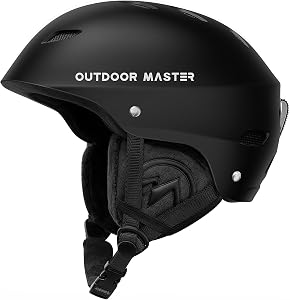
OutdoorMaster Kelvin
The most-reviewed ski helmet on Amazon and where most first-time buyers land. ASTM F2040 certified, nine genuinely adjustable vents rather than a marketing count, and a neutral shape that suits most heads - which is why it accumulates ratings faster than anything else in the category. No MIPS at this price. If you want one recommendation and no further research, take this one.
Check Price on Amazon All helmet picksBuy It With Your Goggles
The helmet brim and the top of your goggles need to meet without a stripe of exposed forehead between them, and the goggle strap needs to sit in the helmet's rear clip rather than riding up over it. Brands fit their own goggles best, which is the main argument for matching them if you are buying both at once.
Order them together and try them on together before removing any tags. The gap between helmet and goggle is a comfort problem long before it is a fashion one - that strip of forehead takes the wind and the sun for the whole day.
Yes, wear a helmet. Check it carries ASTM F2040 or CE EN 1077 and then stop worrying about impact ratings - a $46 certified helmet passed the same test as a $200 one. Take MIPS if the budget stretches, because it addresses rotational injury that standard testing ignores. Never buy used, replace after any real impact, and make sure it does not slide when you shake your head with the strap undone.
Frequently Asked Questions
Do I really need a ski helmet?
Yes. Head injuries are the ones with the worst outcomes in skiing, and a certified helmet costing around $50 measurably reduces them. Helmet use in resorts has gone from a minority habit to near-universal in about twenty years for exactly this reason. Some resorts and most ski schools now require them for children regardless.
Is an expensive ski helmet safer than a cheap one?
Against straight-line impact, no - both have passed the same ASTM F2040 or CE EN 1077 test, and there is no premium pass grade. What more money buys is lighter weight, better adjustable ventilation, a more refined fit system, goggle integration and sometimes MIPS. Those are genuine benefits, and a comfortable helmet is one you actually wear, but they are not a higher impact rating.
Is MIPS worth paying extra for in a ski helmet?
If it fits the budget, yes. Standard certification measures straight-line impacts, but most real falls are angled, and angled impacts twist the head - rotational acceleration that is strongly linked to concussion and that the standard test does not measure. MIPS adds a slip layer that sheds some of that twist, usually for $10 to $30 more. Fit still comes first: a well-fitting non-MIPS helmet beats a poorly fitting MIPS one.
Can I buy a second-hand ski helmet?
No. The protective EPS foam works by crushing, and once crushed it cannot absorb another impact - but that crushing is frequently invisible beneath an undamaged-looking shell. A used helmet has an unknown history and no way to inspect it. The same applies to your own helmet after any real hit: replace it even if it looks fine.
How often should I replace my ski helmet?
Immediately after any significant impact, and otherwise around every five years. The foam liner and the bonding between shell and liner degrade over time with UV exposure, sweat and repeated temperature cycling, so an old helmet protects less than a new one even if it has never been hit. Check the manufacturer's stated lifespan, which is usually printed inside.