A badminton racket is decided by three numbers, and only three: where the weight sits, how much the shaft bends, and what tension the strings are at. Everything else on the packaging is marketing. Head-heavy rackets hit harder and move slower; head-light rackets move faster and hit softer; a flexible shaft forgives a slow arm and a stiff one rewards a fast one. Get those matched to how you actually play and a $35 racket will out-perform a $200 one held by the same person. Below are six that make sense at their price, plus the reason most beginners buy the wrong one.
Last updated: September 2026
| Racket | Tier | Balance | Level | Score |
|---|---|---|---|---|
| Yonex GR 303i | Budget | Even | Beginner | 8.0 |
| Yonex Astrox Attack 9 | Budget | Head-heavy | Beginner+ | 8.3 |
| Senston N80 Carbon Fibre | Best Value | Even | Intermediate | 8.4 |
| Yonex Nanoray 10F | Best Value | Head-light | Intermediate | 8.7 |
| Yonex Astrox Smash | Premium | Head-heavy | Advanced | 8.9 |
| Yonex NanoFlare 1000 Play | Premium | Head-light | Advanced | 9.0 |
First Real Rackets
A genuine step up from whatever came with the net set
The sensible floor of the market. It is aluminium rather than graphite, so it will never feel crisp, but the frame is isometric and the shaft genuinely flexes, which are the two things the bundled net-set rackets get wrong. That is enough racket to learn a clear, a drop and a serve on without building a compensating technique you will have to unlearn. Treat it as a twelve-month racket rather than a keeper.
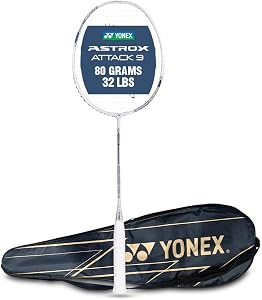
Astrox is Yonex's attacking line, and this is the entry point to it — enough head weight that a smash actually feels like it has something behind it, without the stiff shaft that makes the expensive Astrox frames unusable for a beginner. If you already know you like hitting down and the phrase "play it safe" annoys you, this is the budget racket to pick. The trade is that it comes round slower at the net.
The Step-Up
Where a player who has learned to clear should land
A full-graphite one-piece frame at a price where most rackets are still aluminium hybrids, and that is the entire argument for it. At 76 grams it is genuinely quick, and the one-piece T-joint means the head does not twist independently of the shaft on off-centre hits the way a glued joint does. It is not a Yonex and the finish tells you so, but the thing you actually hit shuttles with is right.

The racket to buy if you want one and only one recommendation. The Hi-Flex shaft loads at an ordinary club swing speed rather than a professional one, and the head-light balance makes the racket arrive early — which is the difference between blocking a smash and watching it. Twenty thousand-odd buyers agree, and it is the racket that most often ends the search for people who keep asking what to get.
Performance Grade
Full graphite frames built around one style of play
A proper attacking racket, and it behaves like one: mass forward, shaft stiff enough that a lazy swing produces nothing at all. Hit through it properly and the shuttle leaves noticeably flatter and faster than anything in the tiers above. Buy this when your problem is that good smashes are being retrieved, not when your problem is getting the shuttle to the back line in the first place.

The counterpart to the Astrox: NanoFlare is Yonex's speed line, built to be somewhere before the shuttle rather than to hit it hardest. In fast doubles the difference is obvious — flat drives and net kills that a head-heavy racket simply cannot get round for. It is the most expensive racket here and also the most specific; if you play singles from the back court, buy the Astrox instead.
How to Choose a Badminton Racket
Balance Point Decides Everything Else
Rackets are sold as head-heavy, even balance or head-light, and this single property changes how the racket feels more than weight or price does. Head-heavy puts mass behind the shuttle, so smashes land harder — at the cost of taking longer to bring the head round for the next shot. Head-light does the opposite: less power, but the racket is where you need it at the front of the court. Singles players and anyone who likes to attack from the back generally want head-heavy. Doubles players who spend their time at the net want head-light. If you genuinely do not know yet, buy even balance.
Shaft Flex Should Match Your Swing Speed, Not Your Ego
A flexible shaft loads and releases like a spring, so it does some of the work for a slower arm. A stiff shaft stores energy only if you swing hard enough to bend it, and gives you back precision in exchange. Almost everyone buying their second racket over-estimates their swing speed here: with a stiff shaft and an average arm, shots feel dead and go nowhere. Flexible or medium is the correct answer until your clears reliably reach the back line.
Weight: 4U Is the Answer Nearly Every Time
Badminton weights run backwards — a bigger U number means a lighter racket. 3U is roughly 85–89g, 4U is 80–84g, 5U is 75–79g. 4U has become the default for good reason: it is light enough to swing quickly through a long rally and heavy enough to still put something on the shuttle. Go 3U only if you specifically want more mass behind your smash and have the arm to move it; go 5U if you are playing mixed doubles at the net or your wrist tires quickly.
String Tension Matters More Than the Frame You Bolt It To
Low tension (18–22 lbs) gives a trampoline effect: more power, less control, and a bigger margin for hitting off-centre. High tension (24 lbs and up) gives a flatter, more precise response but punishes anything that misses the sweet spot, and the strings break sooner. Factory-strung rackets ship around 20 lbs, which is right for most people. Do not chase 27 lbs because a professional uses it — they also have a stringer on site. Our strings and grips page covers restringing.
Isometric Heads and Why Cheap Rackets Feel Dead
The squared-off head shape you see on nearly every modern racket is not styling — it widens the sweet spot by keeping the cross strings closer to equal length. Combined with a one-piece frame, it is the difference between a mishit that still crosses the net and one that dribbles into it. Aluminium rackets with a separate steel shaft, the kind bundled with backyard sets, have neither, which is why they feel dead no matter how hard you swing them.
Frequently Asked Questions
What badminton racket should a complete beginner buy?
An even-balance or slightly head-heavy 4U racket with a flexible shaft, in the $25 to $40 range. That combination is forgiving enough to learn every shot on, light enough not to wreck your wrist, and cheap enough that you have lost nothing when you work out which style of play you prefer. Avoid the aluminium rackets bundled with cheap net sets — the frame flexes so much that the shuttle leaves before the racket has finished bending.
Is an expensive badminton racket actually worth it?
Only once your technique can load it. A $70 full-graphite frame gives you a stiffer shaft and a more precise response, but a stiff shaft only returns energy if you swing fast enough to bend it in the first place. If your clears are still landing mid-court, that money buys you nothing. If your shots feel underpowered despite good technique, the upgrade is real and immediate.
What does 4U or 3U mean on a badminton racket?
It is the unstrung weight class, and the numbering runs backwards. 3U is about 85 to 89 grams, 4U is 80 to 84 grams, and 5U is 75 to 79 grams. Lighter rackets swing faster and tire your arm less; heavier ones put more mass behind the shuttle. 4U is the modern default and the right starting point for almost everyone.
How often should I replace my badminton racket?
Replace the strings, not the racket. A graphite frame lasts years unless you clash it against a partner's racket or the floor. Strings lose tension from the moment they are fitted and go dead well before they snap — if you play twice a week, expect to restring every two to three months even if nothing has broken. A dead string bed is what makes an old racket feel slow, not the frame.
Should I buy a racket that comes pre-strung?
For a first or second racket, yes. Factory stringing at around 20 lbs is a sensible middle setting and it saves you $20 to $25 on top of the racket price. Once you know what tension you want, buy the frame unstrung — or restring a pre-strung one — because factory string is chosen for durability in a warehouse, not for how it plays.