Training aids let you isolate specific parts of your stroke. Kickboards hold your upper body up so you can focus entirely on leg kick mechanics. Pull buoys float your hips and legs so you can concentrate entirely on your pull without kicking. Hand paddles increase the surface area of your hand to build pull strength and emphasise correct catch mechanics. Using these consistently produces measurable improvements in both technique and conditioning within weeks.
Last updated: September 2026
| Training Aid | Tier | Type | Best For | Score |
|---|---|---|---|---|
| Speedo Kickboard | Budget | Kickboard | Kick drills | 7.8 |
| Speedo Pull Buoy | Budget | Pull buoy | Pull drills | 7.9 |
| FINIS Alignment Kickboard | Best Value | Kickboard | Body alignment | 8.8 |
| TYR Pull Float | Best Value | Pull buoy | Hip support | 8.4 |
| Speedo Power Paddle | Premium | Hand paddle | Pull strength | 9.0 |
| Arena Training Bundle | Premium | Bundle kit | Complete kit | 9.2 |
Under $20
Essential kickboard and pull buoy for isolating kick and pull training
Speedo's standard kickboard is the most common board found in pool equipment bins worldwide. The standard foam construction is buoyant, lightweight, and durable enough for years of pool use. The classic rectangular shape with notched sides provides two natural hand positions — extended arms for full-body kick sets, or pulled in close for kick with rotation. A straightforward, reliable kickboard that does exactly what it needs to do.

The classic figure-eight pull buoy for isolating your upper body pull. Held between your thighs, it floats your hips and legs, allowing you to focus entirely on arm mechanics, catch timing, and stroke rate without the distraction of kicking. An absolute essential for any swimmer working on freestyle pull technique or building arm-specific endurance. The figure-eight shape is intuitive to position and stays securely in place.
$15 – $35
Purpose-designed aids for body alignment and hip position correction
FINIS's Alignment Kickboard is not a standard kickboard — it's a targeted technique tool. The narrow, streamlined shape requires you to hold it with your arms extended directly in front of you, forcing a neutral head position and proper spinal alignment. If your head is too high or your hips drop, the board immediately signals the error by tipping. Coaches use this board extensively for fixing poor body position in developing swimmers. It will highlight technical flaws standard boards mask.
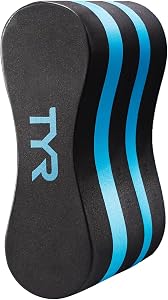
TYR's Pull Float differs from the standard figure-eight pull buoy in its shape — a flatter, wider design that sits more stably between the thighs and provides slightly less buoyancy, meaning your hips won't float unrealistically high. This gives a more natural body position during pull sets and is particularly good for swimmers with broader hips or for those who find standard pull buoys too floaty. Available in two sizes to match your body type.
$30 & above
Hand paddles for strength building and complete training bundles
Hand paddles increase the surface area of your hand, overloading the pulling muscles and providing immediate feedback on catch angle — if your catch is incorrectly angled, the paddle will slip noticeably. Speedo's Power Paddle has a moderate size increase over your natural hand, which is the right choice for most swimmers. Too large and you lose the feel of the water; too small and you get no benefit. The perforated blade lets some water through, reducing shoulder strain on long sets.

If you're kitting out a swimmer from scratch, Arena's training bundle gives you a kickboard, pull buoy, and mesh carry bag in a matched set at a price well below buying individually. The kickboard is contoured (not flat-top) for a more comfortable grip during long sets, and the pull buoy features Arena's ergonomic centre channel that holds it stably between the thighs without requiring a death grip. The mesh bag keeps everything together and drains after pool use. An excellent complete training kit for club swimmers.
How to Use Training Aids Effectively
Kickboard Technique
Hold the kickboard with arms extended and slightly submerged — not held up out of the water. Keep your face down or with goggles just above the surface. Focusing on keeping your hips and feet close to the surface will teach you the correct body position faster than any other drill.
Pull Buoy Positioning
Place the pull buoy in the top third of your thighs, not at the knees. Squeeze gently to hold it in place — if you're squeezing hard, it's the wrong size. The goal is to have your hips floating so you can focus entirely on your catch, pull, and recovery.
Paddle Safety
Never use paddles if you have existing shoulder issues — they significantly increase the load on the rotator cuff. Start with smaller paddles and build up. Always warm up without paddles before any paddle set, and limit paddle sets to 25–30% of total yardage to prevent overuse injury.
Deeper reading
Not sure what to buy first? Our guide to the best swimming training equipment explains what each tool trains and the order to build your kit — fins first, and our fins guide covers the short-vs-long blade choice in depth. Carry it all in one of the best swim bags.
Frequently Asked Questions
Do I need all three training aids, or just one?
The two essentials are a kickboard and a pull buoy — they let you split your training into kick-focused and pull-focused sets, which is the foundation of technique work at every level. Hand paddles come later, once you have solid catch mechanics to reinforce.
Can I use a pull buoy all the time to avoid kicking?
No. It's a common shortcut that creates serious problems — swimmers who rely on pull buoys too heavily lose their kick completely and develop a body position that only works with artificial float. Use it for pull-specific drill sets, not as a permanent crutch.
What size hand paddle should I start with?
Start with a paddle that's the same size as your hand or slightly larger — not much bigger. Over-size paddles (much larger than your hand) are for experienced swimmers who have already established correct catch mechanics. Starting too large leads to reinforcing a bad catch position with more force.
How do I know if my kickboard technique is wrong?
Common errors: holding the board too high out of the water (which lifts your head and drops your hips), kicking from the knee instead of the hip, and a kick that's too wide. Your feet should barely break the surface and your legs should be almost straight with just a slight knee bend.