For half the year, most people who run before or after work are running in the dark, and the kit most of them wear is black. Visibility gear solves two separate problems. Being seen by drivers is about reflective material and lights that move with your body. Seeing the ground is about a beam bright enough to show a kerb or a tree root before you trip on it. On lit streets you mainly need the first; on unlit roads and trails you need both. Below are six options, from a reflective vest that costs less than a coffee to a headlamp built for trail running at night.
Last updated: September 2026
| Light | Tier | Type | Solves | Score |
|---|---|---|---|---|
| Reflective Vest 2-Pack | Budget | Reflective vest | Being seen | 7.7 |
| Lepro Headlamp | Budget | Headlamp | Seeing and being seen | 7.8 |
| ISEYOU Chest Light | Best Value | Chest light vest | Seeing and being seen | 8.2 |
| Viccux Chest Light | Best Value | Chest light vest | Seeing and being seen | 8.3 |
| Petzl Swift RL | Premium | Headlamp | Seeing | 8.9 |
| Noxgear Tracer2 | Premium | Light-up vest | Being seen | 9.1 |
The Essentials
A reflective vest and a headlamp for the price of one lunch
A lightweight strap-style vest with reflective bands front and back, sold as a pair for less than most single vests. It adjusts to fit over a T-shirt or a winter jacket, weighs almost nothing and never needs charging. It only works when a car's lights hit it, so pair it with a light on unlit roads. The cheapest meaningful safety upgrade in running.
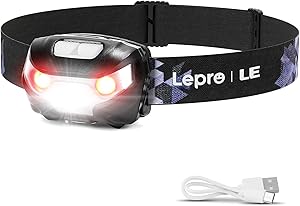
A light, rechargeable headlamp with a red mode, at a price that makes it an easy add to a first dark-running kit. It is bright enough to show the ground on unlit streets and light enough that it does not bounce much once the strap is snug. It is not a trail headlamp and the beam is simple, but for pavements and dark parks it is plenty.
Chest Lights
A steady beam that does not bounce like a headlamp
A chest-mounted light on a reflective harness, so one purchase gives you both a beam and reflectivity. Mounted at chest height the beam barely moves as you run, and the tilting head lets you aim it at the ground a few strides ahead. It is bulkier than a headlamp, but many road runners find it more comfortable. A strong all-in-one choice for dark road running.
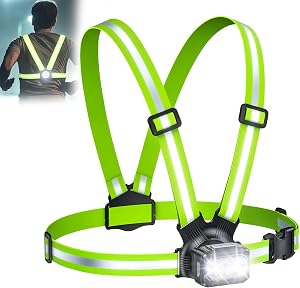
The same idea as the ISEYOU, with a choice between a wide flood beam for nearby ground and a focused spot for looking further ahead - useful if your routes mix lit streets with unlit stretches. The harness is reflective all round. The difference between the two chest lights is small; buy this one if you want the extra beam options.
Seen From Everywhere
A light-up vest and a trail-grade headlamp
A trail-grade headlamp from the brand most night trail runners use. Reactive lighting reads the light around you and adjusts brightness and beam automatically - bright and focused when you look down the trail, dimmer when you look at your map - which extends battery life without you touching a button. The split headband keeps it stable at pace. More than a road runner needs; the right tool for real darkness.

A vest that glows. Fibre-optic strands run around the whole harness and light up in a choice of colours, so you are visible from every direction including the sides, where reflective vests do nothing - and it is reflective and fluorescent as well. It does not light the ground, so add a headlamp on unlit roads. For runners on busy roads before dawn, nothing else here makes you as hard to miss.
How to Choose Running Lights
Reflective Only Works When Light Hits It
Reflective material bounces a car's headlights back towards the driver, which makes it highly visible from the front and behind at night — and completely invisible from the side, under street lights, or to a cyclist without a light. It is the cheapest and most important layer, and it needs no batteries. Add an active light for everything reflective material cannot do.
Movement Is What Drivers Notice
Research on pedestrian visibility consistently finds that reflective material on moving parts — ankles, wrists, knees — is recognised as a person far sooner than the same material on the torso, because the eye picks up the motion of walking or running. A reflective vest plus reflective shoe details or ankle bands is noticeably better than a vest alone.
Headlamp or Chest Light?
A headlamp points wherever you look and is the best tool for trails and technical ground. On a run, though, it moves with your head and can bounce. A chest light is mounted lower, so the beam is steadier and shadows on the ground are longer and easier to read — many road runners prefer it. On unlit trails, a good headlamp is the one to have.
Lumens: How Much Is Enough
For being seen on lit streets, almost any light is enough. For seeing the ground on unlit roads, a few hundred lumens is comfortable at running pace. For trails at night, more is better, and reactive lighting that adjusts to what you are looking at, like the Petzl Swift RL, saves the battery while keeping the beam bright where you need it.
Use a Rear Red Light on Roads
If you run on roads without pavements, a red light on your back tells drivers approaching from behind which way you are facing. Many headlamps and vests have a red mode for exactly this. And whatever you wear, run facing oncoming traffic where there is no pavement — you can see what is coming and step off the road.
Frequently Asked Questions
What should I wear to be seen running at night?
Reflective material plus an active light. A reflective vest is highly visible to drivers whose headlights hit it, and a light makes you visible from the side and under street lights where reflective material does nothing. Reflective details on moving parts - ankles and wrists - help drivers recognise you as a person sooner.
Is a headlamp or chest light better for running?
A chest light gives a steadier beam and longer shadows on the ground, which many road runners prefer. A headlamp points where you look, which is better on trails and technical ground. Both work; if you run mainly on roads, try a chest light, and for trails at night choose a good headlamp.
How many lumens do I need for night running?
To be seen on lit streets, almost any light. To see the ground on unlit roads, around 200 to 500 lumens is comfortable. For trail running at night, 500 lumens and above, ideally with a spot-and-flood beam, makes a real difference. More lumens drain the battery faster, so check runtime at the brightness you will actually use.
Do reflective vests actually work?
Yes, when car headlights hit them - they return the light towards the driver and are visible from a long distance. They do not work from the side, in street lighting, or for cyclists and pedestrians without lights. That is why pairing one with an active light is the safest combination.
Which side of the road should I run on?
Where there is no pavement, run facing oncoming traffic, so you can see vehicles approaching and step aside. Be careful on blind bends, where crossing to the outside of the bend can be safer. Wear something reflective and lit regardless of which side you choose.